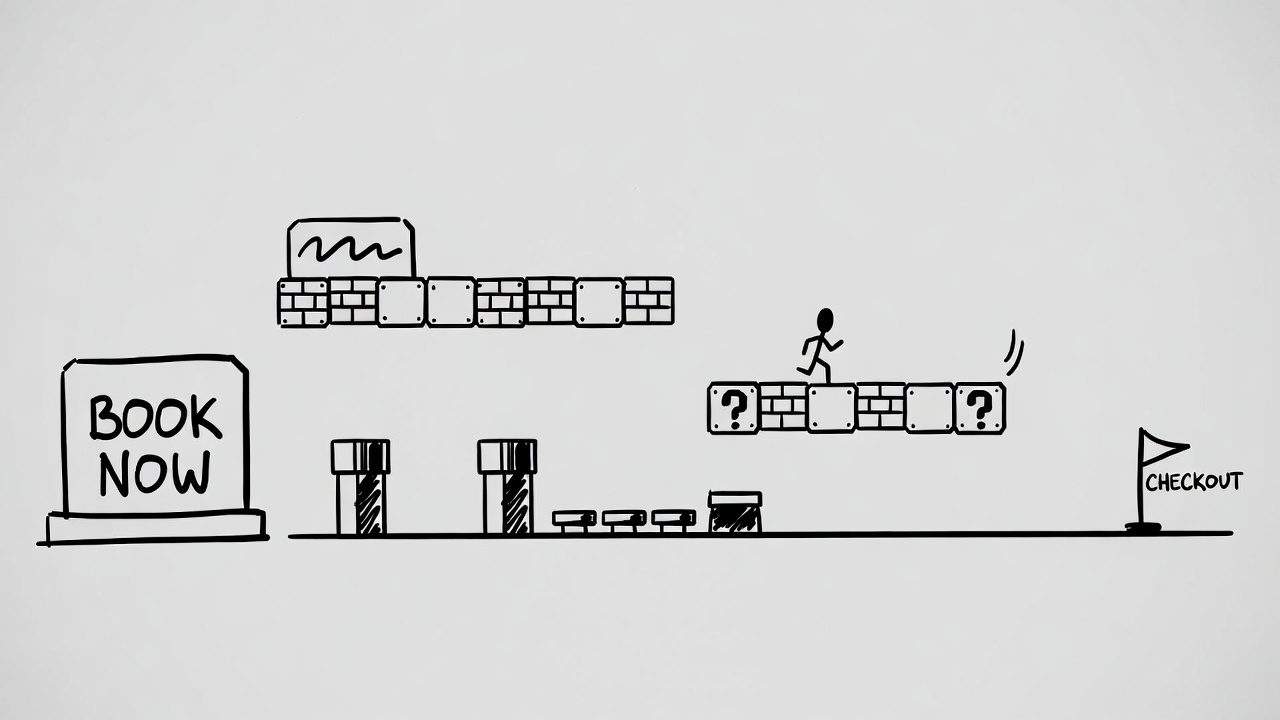
Your Gym's 'Book Now' Button Is Costing You Clients
Most gym websites send prospects into checkout flows that would be unacceptable in any other industry. The data on what this costs — and what to do about it — is hard to ignore.

Every gym website has some version of the same button. "Book Now." "Get Started." "Join Today." It sits in the top right corner, usually in a contrasting color, waiting for the moment a prospect decides to act.
That moment is the most valuable interaction on a gym's website. A person has researched your gym, looked at your schedule, maybe read a review — and they're ready to commit. What happens next determines whether they become a paying member or another bounce in your analytics.
At most gyms, what happens next is a disaster.
The checkout experience behind that button — the actual flow a prospect goes through to give you money — is typically so broken that it would be rejected by any competent ecommerce business. The data from outside the fitness industry tells us exactly how much this costs. The data from inside the fitness industry tells us almost nobody is paying attention.
The Ecommerce Baseline
Before examining gym-specific checkout, it helps to understand what the broader ecommerce industry has learned about conversion over the past decade.
Baymard Institute, which has conducted over 150,000 hours of checkout usability research across 11,777 study participants, publishes the most widely cited data on cart abandonment.1 Their findings on why people abandon checkout are remarkably consistent year over year:
| Reason for Abandonment | % of Users |
|---|---|
| Extra costs too high (shipping, tax, fees) | 39% |
| Delivery too slow | 21% |
| Site required account creation | 19% |
| Didn't trust site with credit card info | 19% |
| Checkout process too long or complicated | 18% |
| Returns policy unsatisfactory | 15% |
| Website errors or crashes | 15% |
| Couldn't see total cost upfront | 14% |
| Not enough payment methods | 10% |
Strip out the reasons that don't apply to gyms (shipping costs, delivery speed, return policies), and three of the top five remaining reasons are forced account creation, lack of trust in the checkout page, and an overly complicated process. These are precisely the problems that gym software checkout flows exhibit.
The average ecommerce checkout contains 23.48 form elements. Baymard's research shows an ideal checkout needs only 6-8 fields.2 Single-step forms convert at 13.67%, compared to 6.85% for multi-step forms.3 Shopify's data is even more pointed: their one-page checkout converts up to 36% better than competitors, and Shop Pay — which uses saved identity and one-tap payment — lifts conversion 50% over standard guest checkout and 91% higher on mobile.4
These aren't marginal improvements. They're structural differences caused by the number of fields, steps, and decisions placed between "I want this" and "I bought this."
Three Checkout Patterns That Kill Gym Conversion
I've spent the past several weeks reviewing gym and studio websites across the country — independents, boutiques, chains. The "Book Now" or "Get Started" button on nearly every one leads to some variation of the same three broken experiences.
Pattern 1: The Contact Form
The prospect clicks "Get Started" and lands on a multi-field intake form. Name, email, phone number, "tell us about your fitness goals," preferred time to visit. They fill it out, click submit, and... wait. No purchase happens. No membership begins. Someone at the gym might call them back in a few hours. Maybe the next day. Maybe never — 14.6% of gyms don't call their leads at all, and that number increased from 2024 to 2025.5
This isn't a checkout. It's a suggestion box. The prospect expressed intent to buy, and the gym responded by asking them to wait for a sales call. In ecommerce terms, this is equivalent to clicking "Add to Cart" and being told someone will contact you about completing your purchase.
Pattern 2: The Account Wall
The prospect clicks "Sign Up" and is immediately presented with a single email input field and two options: create an account or log in. Before they can see a single product, price, or membership option, they need to register for a platform they've never heard of. GymMaster, PushPress, and others use this pattern.
This is the exact behavior Baymard identified as causing 19% of all checkout abandonments.1 The prospect came to buy a gym membership, and the software redirected them into an account creation flow for a third-party platform. The gym's brand, the energy of their website, the social proof they worked to build — all of it is gone. They're now staring at a generic form on someone else's domain.
Pattern 3: The Generic Catalog
Platforms like Mindbody and Mariana Tek take a different approach. Click "Buy Now" and you're sent to an unbranded product catalog — product tiles on a page that doesn't match the gym's website in design, color, or personality. Select a product, and you enter another account creation flow. Then billing address. Then manual card entry — type out all 16 digits, the expiry date, the CVV. The entire experience feels like you've left the gym's website and ended up in a backend admin tool.
For context on how far this lags behind: Shopify merchants using accelerated checkout (saved identity, one-tap payment) see returning users complete checkout over 90% of the time.4 The typical gym checkout asks for 10-15 fields across multiple pages with no saved-state capability.
Why This Matters More for Gyms Than Other Businesses
The conversion gap is costly for any business, but two factors make it disproportionately painful for independent gyms.
Low Lead Volume Means Every Conversion Counts
Half of all gyms get fewer than 14 leads per month.5 At that volume, losing even two or three prospects to checkout friction has a measurable impact on monthly revenue. A retail brand processing 50,000 website visitors can afford a 2% conversion rate and still generate volume. A gym with 300 monthly website visitors and a 2.5% opt-in rate generates roughly 7 leads per month.6 Losing two of those to a broken checkout flow isn't a rounding error — it's a 28% reduction in pipeline.
Mobile Traffic Dominates
When a UK gym chain redesigned for mobile-first checkout, they saw a 300% increase in conversion and their bounce rate dropped from 41.71% to 7.77%.7
Gym websites receive 60-80% of their traffic from mobile devices.78 This matters because mobile checkout abandonment runs at 85.65% — substantially higher than desktop's 73%.9 The checkout flows described above were largely designed for desktop. Multi-step forms, manual card entry, and account creation are particularly punishing on a phone screen, where every additional field means more thumb-typing, more scrolling, and more opportunities to give up.
When a UK gym chain redesigned for mobile-first checkout, they saw a 300% increase in conversion and their bounce rate dropped from 41.71% to 7.77%.7 A gym in Tacoma reported 37% more sign-ups within 60 days of a mobile-first redesign.8 These are dramatic improvements from addressing a single variable: how the checkout works on the device most prospects are actually using.
The Digitalization Gap
These checkout problems don't exist in isolation. They're symptoms of a broader pattern: the fitness industry is one of the least digitalized service sectors in the economy.
EGYM surveyed 257 gym and wellness facility decision-makers and found that 63% have made little or no investment in digitalized member acquisition.10 The breakdown is stark: 37% of gyms have no digital path to purchase at all — members must physically visit the facility to sign up. Another 26% can start the process online but must complete it in person.10 Only 23% allow members to manage their entire membership online, from initial purchase through booking and cancellation.
Meanwhile, the audience is shifting. Gen Z's share of boutique fitness attendance increased 11 percentage points in just two years.11 This is a generation that grew up with one-tap purchases, Apple Pay, and same-day delivery. They have zero tolerance for checkout flows that require creating accounts on platforms they don't recognize, manually entering card numbers, or filling out forms that ask about their "fitness goals" before they can buy anything.
37% of fitness operators cite low guest-to-member conversion as their number-one revenue challenge.12 Yet only 11% plan to focus on improving it.12 The industry recognizes the problem but isn't treating it as the checkout experience issue that it is. Most operators look at conversion as a sales problem — train the front desk staff, follow up faster, offer a better intro deal. Those things matter. But they can't compensate for a checkout flow that loses prospects before a human ever gets the chance to close them.
What Modern Gym Checkout Looks Like
19% of users abandon checkout because they don't trust the site with their credit card information. An unbranded checkout page with unfamiliar software chrome is exactly the kind of experience that triggers this response.1
The principles that drive high-converting ecommerce checkout aren't secret. They're well-documented, extensively tested, and proven across millions of transactions. Applied to gym software, they produce a fundamentally different experience.
A returning member should be able to check out in seconds. Their identity is already known (verified phone number), their payment method is already on file (saved card). The checkout should recognize them immediately and require nothing more than confirmation. This is how every modern consumer platform works — Uber, DoorDash, Amazon — and there's no reason a gym membership purchase should require more steps than ordering a car.
A new customer should encounter the minimum viable checkout: phone number for identity, name, email, and card. Four fields. No account creation for a third-party platform. No password. No billing address (it's a gym membership, not a shipped product). No "tell us about your goals" textarea. Every additional field is a decision point, and every decision point is an opportunity to leave.
The checkout page should carry the gym's brand. Same logo, same colors, same typography. When a prospect clicks "Get Started" and lands on a page that looks like a different business entirely — generic software chrome, no trace of the gym they were just researching — trust drops immediately. Baymard's data shows 19% of users abandon checkout because they don't trust the site with their credit card.1 An unbranded checkout page is exactly the kind of experience that triggers this response.
Gymsense approaches this through what we call smart web checkout — phone-verified identity with saved card support. A returning member enters their phone number, verifies with a one-time code, and pays with their card on file. A new customer enters their phone, name, email, and card details. The entire flow happens on branded pages featuring the gym's logo, colors, and fonts. There's no account wall and no manual card re-entry for returning customers.
See how Gymsense can replace add-ons, simplify daily operations, and give your members a better way to buy, check in, and manage their account.
Talk to usFootnotes
-
Baymard Institute / Statista. "Reasons for Abandonments During Checkout — United States, 2025." Based on 11,777 study participants and 272+ usability test sessions. https://baymard.com/blog/ecommerce-checkout-usability-report-and-benchmark ↩ ↩2 ↩3 ↩4
-
Baymard Institute. "Checkout Optimization: From 16 Form Fields to 8 Fields." https://baymard.com/blog/checkout-optimization-from-16-fields-to-8 ↩
-
FLiiP. "How to Increase Gym Website Conversions by Simplifying the Online Registration Process." https://myfliip.com/blog/how-to-increase-gym-website-conversions-by-simplifying-the-online-registration-process/ ↩
-
Shopify. "Shop Pay: The Best-Converting Accelerated Checkout on the Internet." https://www.shopify.com/blog/shop-pay-checkout; Shopify. "Shopify Checkout: The Best-Converting Ecommerce Checkout." https://www.shopify.com/checkout ↩ ↩2
-
Two-Brain Business. "State of the Industry 2025," Lead Generation and Lead Conversions sections. Based on data from thousands of gyms. ↩ ↩2
-
Two-Brain Business / Kilo. "Measuring ROI: Is Your Gym Website Working?" https://twobrainbusiness.com/measuring-website-roi/ ↩
-
JH Case Study. "Boosting Conversions 300% with a Mobile-First Experience" (Xercise4Less, UK gym chain — 80% mobile traffic). https://wearejh.com/case-study/boosting-conversion-by-300-with-mobile-first-experience-for-gym-lovers/ ↩ ↩2 ↩3
-
Hypereffects. "Boost Your Gym Signups with Smart Web Design Service for Fitness Centers" (Tacoma gym, 37% signup increase in 60 days). https://hypereffects.com/business/web-design-service-for-gyms-and-fitness-centers/ ↩ ↩2
-
Swell. "35 Custom Checkout Statistics for 2025." https://www.swell.is/content/custom-checkout-statistics ↩
-
EGYM. "Digital Transformation in the Fitness Industry" whitepaper. Data collected Jan–May 2022, n=257 gym/wellness facility decision makers. ↩ ↩2
-
Mariana Tek / Xplor. "2026 Boutique Fitness Industry Report." Platform data from 2,300+ locations and 3M+ active users, US and Canada. ↩
-
Promotion Vault. "2025 Fitness Revenue Pulse Survey." Survey of fitness professionals across the industry. ↩ ↩2